Math tutoring · Kindergarten to Grade 7

Elementary math tutoring, Kindergarten to Grade 7

Keats elementary math tutoring follows the BC math curriculum from Kindergarten to Grade 7, in one 60-minute class a week at our North Vancouver and Kitsilano centres. Your child does their school math first, then works through a Keats booklet written from their own learning plan.

Book a $34 Learning Plan SessionText us
Elementary math ideas on cards: place value blocks, a multiplication array, fractions and a number line

What's covered in elementary math, K to 7

These are the Content learning standards in the BC math curriculum for each grade, Kindergarten to Grade 7. Your child's learning plan picks up wherever they actually are, which is not always their grade on the report card.

Kindergarten

  • number concepts to 10
  • ways to make 5
  • decomposition of numbers to 10
  • repeating patterns with two or three elements
  • change in quantity to 10, using concrete materials
  • equality as a balance and inequality as an imbalance
  • direct comparative measurement (for example, length, mass and capacity)
  • single attributes of 2D shapes and 3D objects
  • concrete or pictorial graphs as a visual tool
  • likelihood of familiar life events
  • financial literacy: attributes of coins, and financial role-play

Grade 1

  • number concepts to 20
  • ways to make 10
  • addition and subtraction to 20 (understanding of operation and process)
  • repeating patterns with multiple elements and attributes
  • change in quantity to 20, concretely and verbally
  • meaning of equality and inequality
  • direct measurement with non-standard units (non-uniform and uniform)
  • comparison of 2D shapes and 3D objects
  • concrete graphs, using one-to-one correspondence
  • likelihood of familiar life events, using comparative language
  • financial literacy: values of coins, and monetary exchanges

Grade 2

  • number concepts to 100
  • benchmarks of 25, 50 and 100 and personal referents
  • addition and subtraction facts to 20 (introduction of computational strategies)
  • addition and subtraction to 100
  • repeating and increasing patterns
  • change in quantity, using pictorial and symbolic representation
  • symbolic representation of equality and inequality
  • direct linear measurement, introducing standard metric units
  • multiple attributes of 2D shapes and 3D objects
  • pictorial representation of concrete graphs, using one-to-one correspondence
  • likelihood of familiar life events, using comparative language
  • financial literacy: coin combinations to 100 cents, and spending and saving

Grade 3

  • number concepts to 1000
  • fraction concepts
  • addition and subtraction to 1000
  • addition and subtraction facts to 20 (emerging computational fluency)
  • multiplication and division concepts
  • increasing and decreasing patterns
  • pattern rules using words and numbers, based on concrete experiences
  • one-step addition and subtraction equations with an unknown number
  • measurement, using standard units (linear, mass and capacity)
  • time concepts
  • construction of 3D objects
  • one-to-one correspondence with bar graphs, pictographs, charts and tables
  • likelihood of simulated events, using comparative language
  • financial literacy: fluency with coins and bills to 100 dollars, and earning and payment

Grade 4

  • number concepts to 10 000
  • decimals to hundredths
  • ordering and comparing fractions
  • addition and subtraction to 10 000
  • multiplication and division of two- or three-digit numbers by one-digit numbers
  • addition and subtraction of decimals to hundredths
  • addition and subtraction facts to 20 (developing computational fluency)
  • multiplication and division facts to 100 (first computational strategies)
  • increasing and decreasing patterns, using tables and charts
  • algebraic relationships among quantities
  • one-step equations with an unknown number, using all operations
  • how to tell time with analog and digital clocks, using 12- and 24-hour clocks
  • regular and irregular polygons
  • perimeter of regular and irregular shapes
  • line symmetry
  • one-to-one and many-to-one correspondence, using bar graphs and pictographs
  • probability experiments
  • financial literacy: monetary calculations, including making change with amounts to 100 dollars and making simple financial decisions

Grade 5

  • number concepts to 1 000 000
  • decimals to thousandths
  • equivalent fractions
  • whole-number, fraction and decimal benchmarks
  • addition and subtraction of whole numbers to 1 000 000
  • multiplication and division to three digits, including division with remainders
  • addition and subtraction of decimals to thousandths
  • addition and subtraction facts to 20 (extending computational fluency)
  • multiplication and division facts to 100 (emerging computational fluency)
  • rules for increasing and decreasing patterns with words, numbers, symbols and variables
  • one-step equations with variables
  • area measurement of squares and rectangles
  • relationships between area and perimeter
  • duration, using measurement of time
  • classification of prisms and pyramids
  • single transformations
  • one-to-one and many-to-one correspondence, using double bar graphs
  • probability experiments, single events or outcomes
  • financial literacy: monetary calculations, including making change with amounts to 1000 dollars and developing simple financial plans

Grade 6

  • small to large numbers (thousandths to billions)
  • multiplication and division facts to 100 (developing computational fluency)
  • order of operations with whole numbers
  • factors and multiples: greatest common factor and least common multiple
  • improper fractions and mixed numbers
  • introduction to ratios
  • whole-number percents and percent off a price
  • multiplication and division of decimals
  • increasing and decreasing patterns, using expressions, tables and graphs as functional relationships
  • one-step equations with whole-number coefficients and solutions
  • perimeter of complex shapes
  • area of triangles, parallelograms and trapezoids
  • angle measurement and classification
  • volume and capacity
  • triangles
  • combinations of transformations
  • line graphs
  • single-outcome probability, both theoretical and experimental
  • financial literacy: simple budgeting and consumer math

Grade 7

  • multiplication and division facts to 100 (extending computational fluency)
  • operations with integers (addition, subtraction, multiplication, division and order of operations)
  • operations with decimals (addition, subtraction, multiplication, division and order of operations)
  • relationships between decimals, fractions, ratios and percents
  • discrete linear relations, using expressions, tables and graphs
  • two-step equations with whole-number coefficients, constants and solutions
  • circumference and area of circles
  • volume of rectangular prisms and cylinders
  • Cartesian coordinates and graphing
  • combinations of transformations
  • circle graphs
  • experimental probability with two independent events
  • financial literacy: financial percentage
elementary math, K to 7 main topics at Keats Learning Academy
Main topics at a glance — full course outline above.

Where students get stuck in elementary math, K to 7

  1. Facts to 20, still counted on fingers

    The curriculum moves addition and subtraction facts to 20 from emerging fluency in Grade 3 to developing in Grade 4 and extending in Grade 5. Counting on fingers in Grade 4 uses up the attention the problem needs.

  2. Fractions

    Fraction concepts start in Grade 3, then ordering and comparing in Grade 4, equivalent fractions in Grade 5, and improper fractions and mixed numbers in Grade 6. A gap in one year shows up in every year after it.

  3. Turning words into an equation

    Grade 7 asks for two-step equations and the relationships between decimals, fractions, ratios and percents. Many students can do the arithmetic but cannot yet set up the problem from a paragraph of words.

A worked example

A Grade 7 word problem that becomes a two-step equation, the way your child would see it worked at their desk.

Sample problem · Grade 7, two-step equations

Maya has 5 stickers. She buys 3 packs with the same number of stickers in each, and now she has 20 stickers. How many stickers are in each pack?

  1. Let s be the number of stickers in one pack. Three packs give 3s, plus the 5 she started with: 3s + 5 = 20.
  2. Subtract 5 from both sides: 3s = 15.
  3. Divide both sides by 3: s = 5.
  4. Check: 3 × 5 + 5 = 15 + 5 = 20. It works.

Answer: 5 stickers in each pack.

How the Keats Membership class works for elementary math, K to 7

One 60-minute class a week, in a shared private class: one tutor and one tutor assistant for every 4 to 6 students, each child on their own work.

  1. School math first

    Your child brings their math homework or a worksheet from class. The tutor teaches anything that is unclear, and your child finishes it with help right there.

  2. Then their Keats booklet

    Written from their learning plan and the BC curriculum for their grade: facts practice when facts are the gap, fractions when fractions are the gap, and work above grade level when they are ready for it.

  3. A lesson note every week

    What was covered, how it went and what comes next, in your Keats Parent Account.

Two centres, classes every day

One 60-minute class a week per subject, at the centre and weekly time that suit your family.

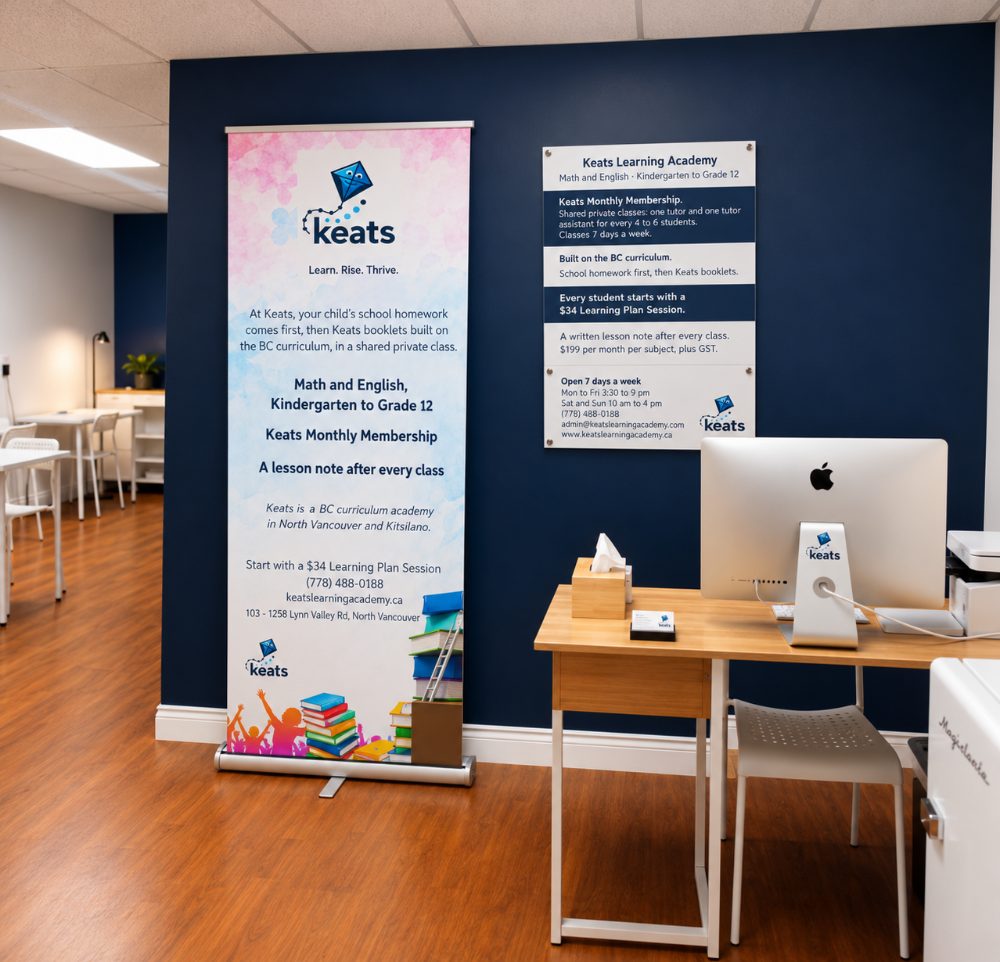
Keats Learning Academy reception at Lynn Valley Village, North Vancouver

North Vancouver, Lynn Valley

103 - 1258 Lynn Valley Rd, Lynn Valley VillageMon to Fri 3:30 to 9 pm · Sat and Sun 10 am to 4 pm(778) 488-0188

Families come from Lynn Valley, Lonsdale, Deep Cove, Edgemont, Seymour and West Vancouver.

Math tutoring in North Vancouver
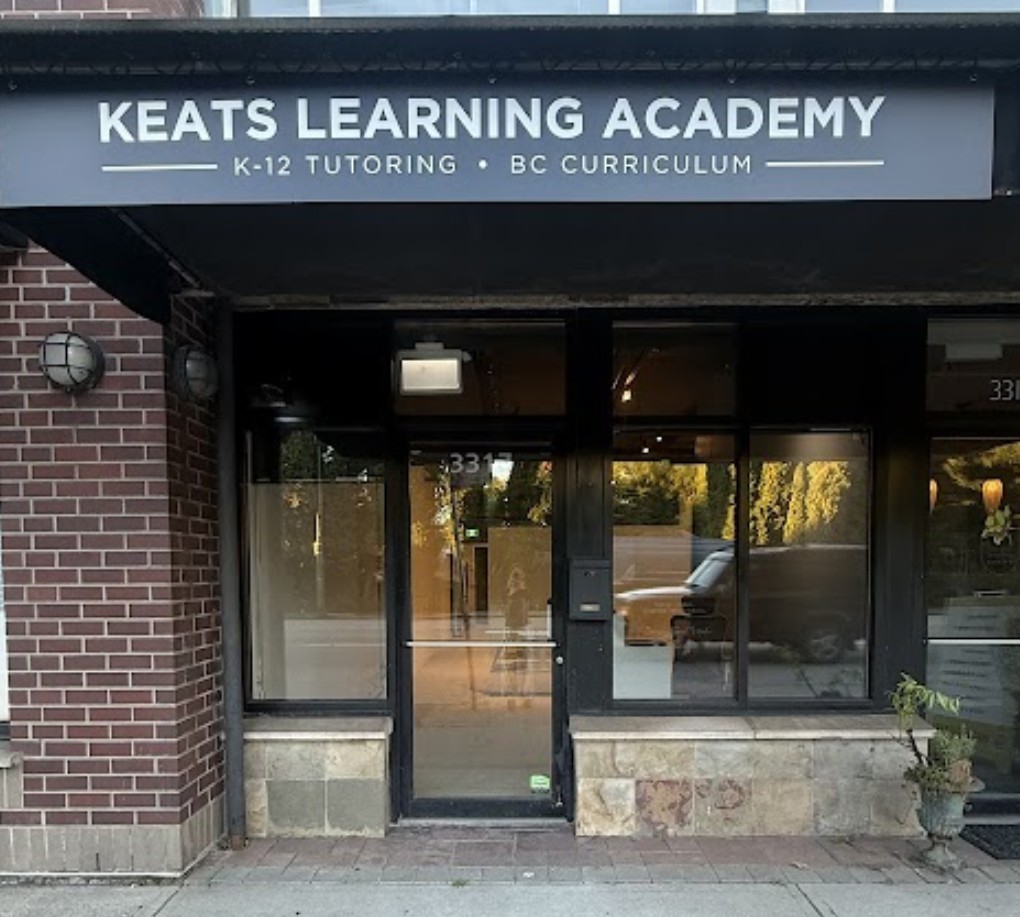
Keats Learning Academy storefront on West 4th Avenue, Kitsilano

Kitsilano, Vancouver

3317 W 4th Ave, VancouverMon to Fri 3:30 to 9 pm · Sat and Sun 10 am to 4 pm(778) 488-0188

Families come from Kitsilano, Point Grey, Dunbar, Kerrisdale, Fairview and downtown.

Math tutoring in Kitsilano

Elementary math tutoring questions

What ages is elementary math tutoring for?

Kindergarten to Grade 7. The learning plan sets the level, so a Grade 3 child working on Grade 2 facts, or a Grade 5 child ready for Grade 6 fractions, works at the right level in the same class.

My child counts on their fingers in Grade 4. Should I be worried?

It is worth working on. The BC curriculum expects addition and subtraction facts to 20 to be developing toward fluency in Grade 4, and multiplication and division facts to 100 follow. The booklet builds the facts a little every week alongside school work.

How long is a class, and how often?

One 60-minute class a week per subject, at the same weekly time. Two hours a week in the same subject is available when a child has a lot to catch up on.

How do we start?

With a $34 Learning Plan Session, plus GST: 45 minutes one-on-one with a senior Keats tutor, on one subject, and a written learning plan you keep. If your child does not need tutoring, we will tell you. You can also text us at (778) 488-0188 with a question first.

Get this term's timetable by text

Leave a first name and a mobile number and we will text you this term's class times at the centre you choose. No email needed.

Start with a $34 Learning Plan Session

45 minutes one-on-one on math with a senior Keats tutor, and a written plan you keep. If your child does not need tutoring, we will tell you.

CallTextBook $34